


SHARED ENVIRONMENTS
A Four Nations Awarded Project

DOWLOADABLE SHARED ENVIROMENTS LEAFLET
SHARED ENVIRONMENTS
A Signdance / Four Nations Outdoor Journey
Opening Statement — Shared Environments
Shared Environments is a live outdoor encounter — a place where news, protest, digital noise, weather, terrain, and human connection collide in real time. Across forests, riversides, islands, parks, festivals and city streets, two works travelled with us: NOTIZEN / THE NEWS and STREAM WALKERS. Together they form a double lens on how we move, communicate, and stay connected in a world shaped by information, climate, and technology.
NOTIZEN / THE NEWS
NOTIZEN unfolds in public space — a meeting point of bodies, signals, and shifting weather — where news, protest, and love collide. Characters move through a world saturated with information: headlines flashing, whispers rising, gestures repeating like echoes. Signdance Theatre’s fusion of sign languages, dance, and theatre gives this turbulence a physical pulse — a language of clarity, resistance, and connection.
Transmitter Performance, led by composer Angelina Schwammerlin, threads the piece with an elemental musical landscape co‑composed with David Bower, whose Deaf-led musical dramaturgy shapes vibration, rhythm, and silence as equal forces. Slovenian puppetry artist Barbara Bulatović expands the world with delicate, uncanny object theatre — surreal images that shift the air and linger long after the scene dissolves.
NOTIZEN is part signal, part ritual, part collective breath — an outdoor performance exploring how news shapes the way we live together.
STREAM WALKERS
STREAM WALKERS steps into the digital present: a character walking through town immersed in a screen, seeing the world through an AI lens. Today’s society is not far from this figure — people moving through cities staring into phones, becoming Web Walkers. The show reveals our fascination with artificial intelligence and the way technology shapes our attention, our movement, and our relationships.
A hybrid street‑theatre format by Ana Monro Theatre, STREAM WALKERS merges live outdoor performance with multi‑camera digital streaming. Signdance Group / Znakovni Ples integrate inclusive performance to expand the work’s accessibility and artistic reach.
Our collaboration during Shared Environments, supported by the Four Nations International Fund, marked a major evolution in how mixed‑ability ensembles create outdoor performance. Deaf, Disabled, DeafBlind, sight‑impaired and non‑disabled artists explored new ways of leading, cueing, moving and communicating in real terrain and shifting light. Multi‑sensory communication — tactile cues, proxemics, multilingual signing, vibration signals, acoustic tracing, environmental listening — reshaped the dramaturgy and challenged traditional hierarchies.
NO EXCUSES — A Shared Methodology
From this collaboration emerged NO EXCUSES — a practice built on trust, accountability, and the removal of barriers that limit artistic participation. It centres Deaf and Disabled leadership, prioritises environmental responsiveness, and builds access directly into choreography, staging, timing, and dramaturgy. NO EXCUSES creates resilient performance structures capable of functioning in forests, riversides, parks, festivals, islands and urban spaces.
Technical & Artistic Breakthroughs
Across summer development sessions, Signdance Collective, Ana Monro, 73 Degree Films and Transmitter Performance explored:
-
cueing systems for Deaf, DeafBlind and physically disabled artists
-
terrain tracing and safe movement pathways
-
acoustic delivery and sound‑tracing
-
performer sightlines
-
ensemble safety placement
-
tactile cues for transitions
-
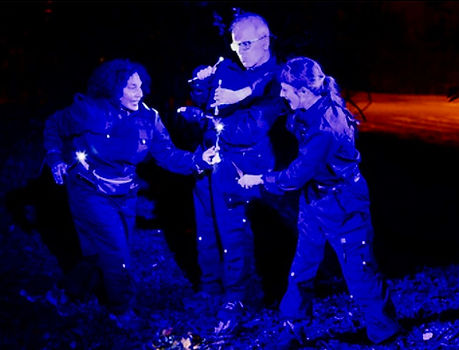
light‑responsive movement for night‑time work
A major breakthrough came with the ideas to use a roving camera instead of a static image — allowing performers to use the camera’s light as an adaptive tool and making the piece more accessible for David. The multi‑camera setup became part of the dramaturgy itself: a structured improvisation shaped by shared cues, environmental awareness and collective responsibility.
A Transformative Collaboration
Ana Monro witnessed how disability‑led methods deepen ensemble connection, sharpen environmental awareness, and generate powerful audience engagement. The Shared Environments team modelled a way of working where communication is multi‑sensory, leadership is shared, and every performer contributes to clarity and safety.
This collaboration strengthened our international network and laid the foundation for future co‑productions. NO EXCUSES now stands as a core methodology — a living practice shaped by the artists who use it, the terrains we work in, and the communities we meet. It forms a central pillar of our Perform Europe development.
Why NO EXCUSES Matters
NO EXCUSES is a call to action:
-
No excuses for inaccessible processes.
-
No excuses for excluding Disabled or Deaf artists.
-
No excuses for outdated hierarchies.
-
No excuses for ignoring the environment.
It is a methodology built from lived experience, artistic experimentation and international collaboration — and it represents the future direction of Shared Environments and Signdance Collective’s inclusive touring practice.
Part 2
Signdance Collective (UK) • Znakovni Ples (Croatia) • Ana Monro Theatre (Slovenia) • Transmitter Performance (Austria) • 73 Degree Films (Wales )
What Shared Environments Is
Shared Environments is an international outdoor performance journey exploring how Deaf, disabled, deafened, sight‑impaired and physically disabled artists create work in real weather, real terrain, and real public spaces.
Across the tour, performers adapted to heat, wind, darkness, noise, uneven ground and shifting conditions — without interpreters or add‑ons on stage . Everyone signs. Everyone adapts. Everyone works together. Communication comes from within the ensemble — a shared language built through signdance, movement, rhythm and awareness.
Across Europe we performed — through wind, heat, noise, trees, riverside storms, and even security barriers. The work never stopped. The voice never dimmed. The performance always spoke.
-
Graz (Austria) — Parks, shade, council‑supported hospitality, and audiences who settled in and stayed with us during the development and the premieres of NOTIZEN .
-
Maribor (Slovenia) —LENT Festival : Riverside wind, late‑day light, and an excellent, attentive crowd. Ljubljana
-
Ljubljana (Slovenia) — NOTIZEN under the trees, beautifully paced, with outstanding support.
-
Wales (UK) — Wrexfest: unforgettable, noisy, vibrant — a festival that met NOTIZEN's energy beat for beat .
-
Croatian Islands — 40°C heat, shade‑based choreography, and a team that adapted without breaking and the youthful audience rose to meet the stride, strength and beauty of NOTIZEN .
-
England (UK) — Open Weekend, Bucks Culture: Rain fell, barriers rose — NOTIZEN still spoke.
Guest artists joined across borders:
Scot Baines ( Neurodiverse Welsh Jounalist) Zhiling Guo (PHD Candidate University Of Warwick) , England , Luka Hameter (DeafBlind photographer Graz Austria ) — each contributing new perspectives and strengthening the shared methodology.
How We Worked Outdoors
Outdoor performance demands adaptation.
The ensemble developed simple, powerful methods:
-
Preparation Arriving early, before the city wakes. Feet on the ground, eyes scanning the space. We map the terrain, test the light, feel the air. The environment sets the score — we listen.
-
Terrain Investigation We walk the ground slowly, like reading braille with our whole bodies. Safe pathways, pockets of shade, sudden obstacles — all become part of the choreography. Nothing is assumed. Everything is learned through touch, sight, and shared awareness.
-
Pacing Movement shifts with the weather. Heat slows the body. Darkness stretches time. Wind demands resistance. The ensemble adjusts rhythm moment by moment, letting the climate write the tempo.
-
Breath & Water Breath becomes a stabiliser. Water becomes a partner. In extreme temperatures, the body speaks first — we follow. Energy is regulated through breath‑timing, hydration, and collective pacing.
-
Shade & Breaks Shade is survival. Breaks are part of the score. Daytime work demands softness inside the intensity — a pause, a reset, a moment to cool the skin and clear the senses.
-
Environmental Awareness Wind, sound, light — All of it enters the work. We respond, not resist. The ensemble stays open to the environment’s interruptions, letting them shape gesture, timing, and emotional tone.
-
Shared Cues Signals travel through the group like pulse. Stable cues for Deaf, DeafBlind and sight‑impaired performers — tactile, proxemic, directional. Communication becomes a living system, built from trust, touch, and ensemble intelligence.
These approaches came from lived experience — and from working together as one ensemble.
Anecdotes From the Tour
Ljubljana — NOTIZEN under the trees A calm, shaded performance with excellent support. The ensemble found a relaxed, steady rhythm before, during and after the show — PACE, BREATH, WATER, PLANNING, AWARENESS.
Croatian Islands — 40°C The ensemble slowed the choreography, worked in shade, and used breath‑based pacing to stay safe and expressive.
Wrexfest — Wales Performing beside a rock festival, the group tested vibration‑based cues and obstruction awareness — proving that communication can thrive even in extreme noise.
Graz, Austria — The city council provided refreshments for audiences — a gesture of care that matched the ensemble’s own commitment to audience comfort.
Maribor, Slovenia — LENT Festival’s riverside wind transformed puppetry, making objects part of the environment.
High Wycombe England— Rain pushed us indoors, security pushed back, but the audience stayed and the performance spoke anyway.
The Organizations
Signdance Collective (UK) A 40‑year disability‑led company pioneering signdance theatre — where movement, sign languages and music create a unique visual performance language.
Znakovni Ples (Croatia) Signdance Europe’s home base, supporting international touring and development.
Ana Monro Theatre (Slovenia) Masters of outdoor performance and dramaturgy.
Transmitter Performance (Austria) Innovators in interdisciplinary music and visual‑music dramaturgy, bringing depth and clarity to NOTIZEN.
73 Degree Films (Rob Corcoran) Exploring streaming, digital intervention and adaptive filming for outdoor signdance — especially in night‑time environments.
Shared Environments shows that outdoor performance can be:
-
inclusive
-
adaptive
-
resilient
-
creative
-
international
It proves that disability‑led methods offer powerful tools for working in unpredictable environments — and that outdoor arts grow stronger through collaboration across nations.
PART 3 — Findings Methods & Artistic Practice
Working in Shared Environments
Outdoor work doesn’t wait for you. It doesn’t soften itself. It gives you heat, cold, glare, wind, uneven ground, people passing, dogs barking, shadows shifting — and you meet it with your body.
Shared Environments brought two opposite worlds into one field:
-
NOTIZEN (day) — bright, exposed, social, loud, public.
-
Stream Walkers (night) — torches, reflections, water, quiet intensity, shadow‑language.
Day and night pulled the ensemble in different directions, and that tension became the research.
Artistic Strengths
Every partner carried a distinct artistic muscle:
-
signdance + puppetry (NOTIZEN)
-
night‑time light dramaturgy (Stream Walkers)
-
disability‑led movement language (SDC)
-
Deaf-informed music & interdisciplinary composition (Transmitter)
-
outdoor dramaturgy (Ana Monro)
-
object theatre (Barbara Bulatović)
-
film & virtual access development (73 Degree Films)
Together, these practices formed a rough, beautiful, cross‑border engine.
Hybrid Vocabulary Developed
The ensemble built a vocabulary shaped by terrain and necessity:
-
signdance
-
puppetry
-
object manipulation
-
light‑responsive gesture
-
environmental listening
Nothing was invented in a studio — everything came from the ground, the weather, the night.
Access & Climate‑Responsive Methods
Access as Creative Engine
Access is not support. Access is structure. Access is choreography.
The ensemble built access into every step:
-
mapping uneven ground
-
adaptive footwork
-
tactile & proxemic cues
-
rest, pacing, sensory regulation
-
movement that anticipates change in the environment
Access kept the work alive, safe, and expressive — not reduced, not compromised.
Communication Systems
Outdoor conditions break standard signing. Glare blinds you. Wind steals your hands. Distance distorts meaning. The ensemble adapted with:
-
enlarged signing
-
directional gestures
-
shadow‑based cues
-
light‑responsive movement
-
tactile communication for DeafBlind performers
Communication became a shared, shifting language shaped by the environment.
Visibility as Artistry
Light becomes a collaborator:
-
torches, lanterns, reflective materials
-
controlled shadows
-
expanded signing in bright sunlight
Visibility isn't a problem — it is a dramaturgical tool.
Climate‑Responsive Practice
The ensemble tested how bodies survive and create in shifting conditions:
-
heat — hydration, shade, pacing
-
cold — layering, breath‑timing
-
wind — anchored gestures, weighted objects
-
darkness — light cues, reflective surfaces
-
unstable terrain — slow‑mapping, shared balance
Unpredictability wasn’t an obstacle — it was part of the score:
-
light & shadow as communication
-
ensemble care as structure
-
letting the environment “speak back”
Findings, Recommendations & Future Directions
Key Findings
-
Outdoor environments demand adaptive, disability‑led methods
-
Access structures increase creativity
-
Mixed‑ability ensembles thrive through interdependence
-
Climate conditions shape dramaturgy
-
Light, shadow, water and terrain become expressive partners
Surprises
-
multilingual signing shifts quickly outdoors
-
puppetry transforms in wind & moving light
-
night‑time performance heightens ensemble cohesion
-
environmental extremes create new emotional textures
Further Research
-
climate‑responsive touring models
-
sustainable independent access provision
-
cross‑border sign language systems
-
documentation for unstable environments
-
day vs night methodologies (NOTIZEN = day, Stream Walkers = night)
Future Directions
-
deeper outdoor development of both works
-
expanded multilingual signing systems
-
touring across Europe & the Caribbean
Potential Co‑Productions
-
new outdoor signdance works
-
interdisciplinary residencies
-
international training labs
-
expanded digital & streaming experiments
Shared Environments continues as a transnational, disability‑led practice — listening to the environment, moving with i intelligence, and creating with resilience.



As a disability‑led ensemble working internationally, Signdance Collective is committed to Fair Work principles that uphold dignity, equality and creative wellbeing. We ensure fair pay, accessible working conditions, and shared decision‑making for all artists, and we collaborate only with partners who respect inclusive, ethical and transparent practice.
Leaflet Statement
This leaflet is a living document — a contribution to the Shared Environments methodology. What you see here reflects the results of the Four Nations project so far, and it will continue to grow, shift, and expand as new works, new collaborations, and new discoveries emerge. It is designed to evolve alongside the practice itself — an open, ongoing record of how artists adapt, communicate, and create in changing outdoor environments.