


CARNIVAL PULSE
Inspired By The R&D "Places Faces & Broken Hearts"


CARNIVAL PULSE A raw, physical collision of Signdance, Commedia, and human stories.
R&D Result 3 Excerpt
USA outdoor movement & Ideas research.
Film by Rob Corcoran & David Bower
Paintings by Viviana Molinares

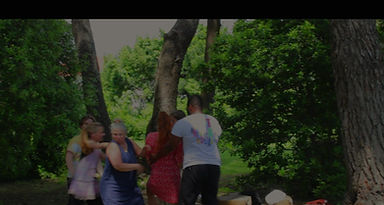
Movement & Character Exploration
NYC Movement Exploration
CARNIVAL PULSE is inspired by SDC’s R&D ACE -Funded Places, Faces and Broken Hearts and marks the company’s first Gothic‑Commedia‑inspired Signdance Theatre production. Created for outdoor evening touring, the work is designed to meet communities where they are — unfolding in courtyards, forests, parks, small squares, playgrounds, and other public spaces that become active parts of the storytelling.
Blending Signdance Theatre’s visual language with contemporary Commedia dell’Arte practice, the production interweaves a 16th‑century Venetian narrative with the lived experiences of its international Deaf, disabled and non‑disabled cast. At its centre is Truffaldino, the quick‑witted servant tasked with delivering a letter from the merchant Pantalone to the widow Smeraldine, all while navigating the determined affections of Columbine.
Alongside this classic storyline, the “rehearsal room” world reveals the performers’ own dreams, vulnerabilities, and unspoken connections. These personal narratives mirror the wider social realities they inhabit, allowing the cast to move fluidly between myth and lived experience. Through Signdance Theatre’s embodied, multilingual approach, archetypal characters and emotional landscapes become accessible to diverse audiences — making the invisible visible and the unheard heard.
CARNIVAL PULSE champions inclusive practice, low‑carbon touring, and community‑centred engagement. By bringing high‑quality performance directly into public spaces, the production strengthens local cultural life, widens access, and invites audiences to encounter a reimagined Commedia that speaks to contemporary identities, resilience, and interdependence.
Shadow Exploration


Croatia


Artists Reflection
Draft Visual Script Development David Bower & Isolte Avila
STORY


Commedia History Mask Research by David Bower.pdf




CARNIVAL PULSE — Dramaturgical Line (Developed + Interwoven)
A — Opening: Two Worlds Revealed
The performers appear first as shadows — bodies preparing, not yet characters.
When they step forward, they introduce both identities:
Commedia Archetypes:
Truffaldino, Pantalone, Smeraldina, Columbina, Il Dottore, Il Capitano, La Strega (Barbara).
Personal Selves:
Isolte — The Dancer / The Intruder / The Heart
David — The Poet / The Actor / The Voice of Reason
Golda — The Mime / The Mirror / The Silent Witness
Rob — The Philosopher / The Trickster / The Shadow‑Maker
Barbara — La Strega / The Enchantress / The Shadow‑Guide
The audience sees immediately that each performer carries two worlds.
A Gothic‑Commedia dance shows the outer world.
A slow‑motion Butoh sequence behind the screen reveals the inner world.
Signdance becomes the bridge between them.
A first personal revelation cracks the mask.
A frozen Commedia tableau begins the story:
Truffaldino receives the letter from Pantalone.
B — Middle: Worlds Collide
The Commedia story begins — Truffaldino’s mission, Pantalone’s schemes, Columbina’s pursuit.
But the performers keep slipping out of character:
A backstage fight interrupts the Commedia world.
A signdance reconciliation reveals the personal relationships underneath.
La Strega (Barbara) breaks the frame entirely with her puppet story — a moment where the personal world takes over the stage.
The duet between Isolte and David shows how their personal identities influence their Commedia roles.
The shadow imagery created by Rob and Golda blurs the line between the two worlds.
Audience participation pulls spectators into this shifting reality.
C — Final: Worlds Merge
Backstage banter, an explosion, smoke — the performers as people, not characters.
Then the personal stories arrive:
Rob’s philosophical reflection
David’s poetic confession
Golda and Isolte’s signdance responses
Barbara’s shadows weaving through everything
These stories reshape how the audience sees the Commedia characters.
The Commedia story returns — but changed:
Truffaldino’s chaos becomes human
Pantalone’s greed becomes fragile
Columbina’s desire becomes agency
Smeraldina’s ending becomes self‑determined
La Strega closes the story, binding the two worlds together
The piece ends with both layers visible at once —
the mask and the human, the outer and the inner, the carnival and the pulse.
A Short History Of Commedia Del Arte By Rob Corcoran -
Project Performer Collaborator Creator
Director 73degreefilms
Commedia, Sign Dance & Mask Exploration
SDC's work is necessary and valuable to communities and encourages participation and reach to audiences who don’t engage in theatre in buildings which can be off-putting, alien and even inaccessible to audiences. It’s so important to immerse folk in their everyday spaces. Your integrity, determination, generous spirit, and artistic qualities moved me.
Assessment Excerpt by Zoe Partington
